Super Bowl LX had timely and incredible Latino participation, with Bad Bunny at the head. The show began with a phrase that would mark the next 13 minutes of a more than simple show, representing the entire message that Bad Bunny wanted to leave with his presentation: “Que rico es ser latino” (How wonderful it is to be Latin).
Followed by an elegant montage where Bad Bunny presented the show and his own full name, Benito Antonio Martínez Ocasio, not just his first name or his stage name.
Then, honoring the roots of Puerto Rico and the rest of the Spanish-speaking islands, Bad Bunny sung “Tití Me Preguntó,” in a white suit holding a football, strolling among sugar cane, the traditional stalls of Puerto Rico (and all of Latin America) and above all, the people.
The people were not dancers, they were the coconut salesman, the elderly sitting at the table playing domino, the boxers training, the cane harvesters, the chef of the tacos. In short, people of the common that can be found in any Latin American town.
After that, the famous “Casita de Benito” appeared, which is becoming a tradition in the presentations of Bad Bunny, a little house for famous people where they dance the songs of Bad Bunny, but as if they were a VIP box where they are participants of the spectacle and not spectators.
Among the guests were Karol G, Cardi B, Jessica Alba and Pedro Pascal, who started dancing to “Yo Perreo Sola” and segments of “Safaera” along with dozens of dancers. The stadium was part of the show, filling in phrases that Bad Bunny did not recite.
Next, Bad Bunny smashed the roof of the house and entered while short clips of three of the foundational songs of the reggaeton play. One of the most overlooked details is that these songs are “Pa’ Que Retozen,” “Dale Don” and “Gasolina” belonging to Tego Calderon, Don Omar and Daddy Yankee.
They are not only singers, they are legends of the musical genre, who popularized it with these songs at the beginning of the 2000s. It wasn’t just a detail, it was a tribute to those who built the road that Bad Bunny now walks.
After the performance of “VOY A LLeVARTE PA PR” and “EeO” on a white van, there was silence. Soon, violins entered the scene, marking the introduction of “MONACO” while Bad Bunny encourages everyone to fulfill their dreams and sings the first verses.
Then, all the attention goes to a very Latin American marriage. The guests, dressed in Caribbean white, accompany the couple as they kiss and make way for Lady Gaga, who appears by a salsa band, who performed “Die With a Smile,” while the guests become dancers and fill the Levi’s Stadium with the best Latin flair.
Bad Bunny and Gaga sang “BAILE INoLVIDABLE” while strolling through several scenes of the wedding; the couple cutting the cake, a child sleeping in the chairs, guests dancing, children running and dodging couples on the dance floor, and circles back to the couple sharing their first moments as husband and wife. Love becomes the central element of this performance.
However, Benito pulls himself off the balcony, only to be pulled down by dancers representing Puerto Rican citizens, because we are no longer on a balcony where there is a marriage, now the set is a street of San Juan, the capital of Puerto Rico, as “NUEVAYoL” plays. The band accompanies from the balcony, and Bad Bunny brings out his best reggaeton style.
Suddenly, the music stops. A family watches as Bad Bunny gets his Grammy on a TV, and then he shows up to give it to the young boy. A musician appears playing the national instrument of Puerto Rico, a cuatro, acting as the curtain to Ricky Martin, who plays the most emotional part of “What happened to Hawaii,” a very subtle reference to the expansionist intentions of the Trump administration.
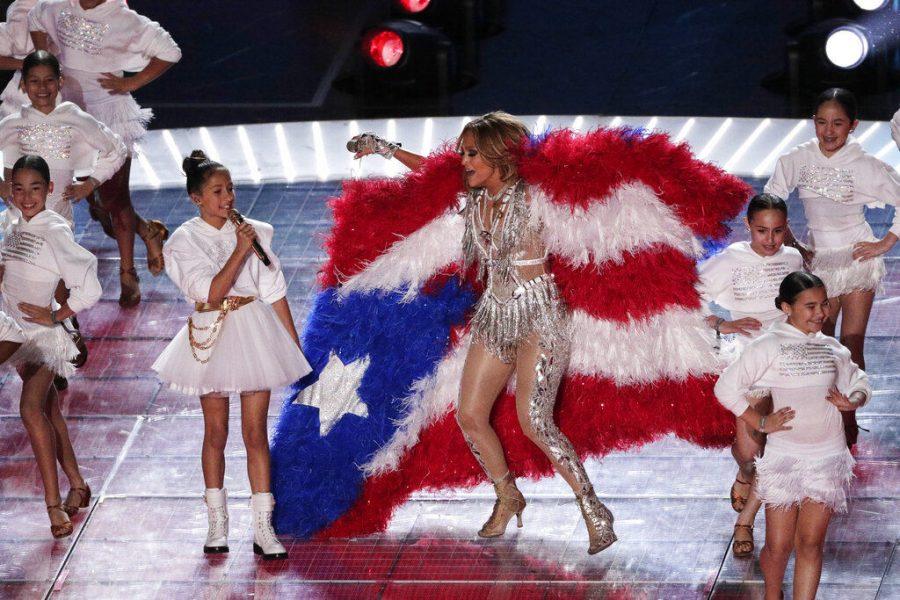
The lights are interrupted, light poles appear between the sugar reeds, and now, with the flag of his homeland, Benito appears again as a champion of independence. With the flag waving on his shoulder, there is the announcement of “El Apagón,” which hides a deeper context, not only lyrically, but of the history on the island.
As he continues to sing, Bad Bunny climbs one of the electrical poles that were a part of the set, and sings until it sparks. The blackout marks the start of “CAFé CON RON,” before a crowd with flags from all American nations appears to escort Benito on his final walk.
Benito recites one by one the names of 24 countries of the American continent, along with the Caribbean Antilles, all to end with the name of Puerto Rico, as a crowd holds flags and bongos.
And finally, he triumphantly leaved the stadium, among the common people, the ones that we just saw in this representation of Puerto Rico, and the pyrotechnic fires of Levi’s, leaving a red but triumphant atmosphere, to the rhythm of the jewel of the last album of Bad Bunny, named with an acronym that represents the name of the album: “DeBÍ TiRAR MáS FOToS.”
Marshall McLuhan, a Canadian philosopher of great influence among communication theories, once proposed that “the medium is the message” by alluding to the fact that the channel through which a message, a content, is transmitted is itself a message.
Bad Bunny, or Benito, made use of this theory almost perfectly. At no time is there any mention of a political speech, because the presentation is itself a political speech, a statement of pride towards a population outraged and persecuted during the last months.
It is the presentation of everything that the Latin American population values, the taste of music and joy. But not an uncontrolled joy, it is one who understands that, despite the difficulties, joy remains an option to live. The joy of love.