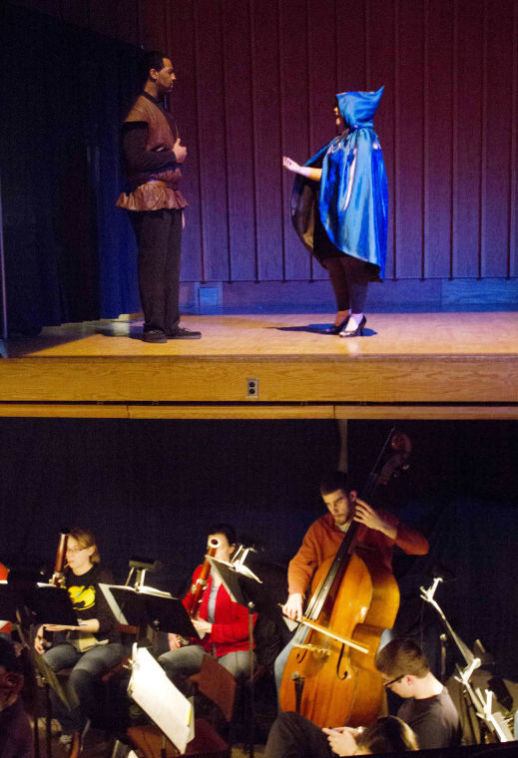
“Tonight, we come together as one to challenge, inspire and remind us how powerful music can be,” said performer Chenoa Randolph, setting the stage for the NIU Opera Theatre’s “Voices for Change 2025” performance on Thursday in the Boutell Memorial Concert Hall.
Under the guidance of director David Charles Tay, the performance was a beautiful showing of musical storytelling, taking the audience through a narrative of struggle, cynicism and unity. The program, which ranged from Mozart to modern musical theater, shared one theme: the power of a voice and the change that comes from sticking together.
The night opened with the full company’s performance of “Way Down Hadestown.” The ensemble didn’t just sing the song, they acted it, using the entire stage to bring the grim, industrial underworld of Hadestown to life. Their collective sound was immersive, establishing a world in need of change.
“Love and perseverance can thrive, even in the darkest of places,” Randolph said.
The program then pivoted to satire as a form of protest. EmVi Nullas Legaspi delivered a playful performance of Kurt Weill’s “When Man was First Created.” Followed by “How can you tell an American,” along with Matthew Skirmont and Gunnar Magnuson’s strong chemistry, this song had the audience laughing as they dissected American values and hypocrisy.
Maggie Garner’s rendition of “Schicklgruber,” a satirical criticism of Adolf Hitler, was one of the vocal standouts of the night. She made the notoriously difficult song sound easy, effortlessly flipping between her chest and head voice to jump to the different notes.
“Today we celebrate the work and its ability to encourage us to think and to laugh in the face of fascism,” Garner said.
The concert then looked into the reality of fascism, exploring a world defined by cruelty and injustice.
“People turn a blind eye to the suffering of others, because they’re so accustomed to it, as if it’s some fact of life,” said Isabella Froh before “The World is Mean.” The trio of Froh, Annalee Kalbfleisch and Legaspi delivered a performance that felt cold and weary, with Legaspi’s voice radiating a deep-set anger.
This theme of struggle was translated into classical music with two powerful songs. Daniel Chukwunyem’s performance of “La Vendetta” carried the feeling of plotting an uprising, sung fully in Italian. Katyi Miller’s “Dido’s Lament” showcased her brilliant physical storytelling, with her body language showing a grief that was beautiful and haunting.
The show took an uplifting turn with Scott Joplin’s “Wrong is Never Right.”
“Revenge never fixes anything; it just proves the other person had the power over you,” said performer Joseph Quaynor.
His powerful voice, a sharp contrast to his lighter speaking voice, turned the song into a moral anthem.
This uplifting theme of community and solidarity carried through the rest of the night. Emily Kmetz and Kayti Miller’s voices blended beautifully in “Sull’aria,” an ode to female conspiracy and agency. Matthew Skirmont and Kmetz then portrayed a perfect contrast of sadness and comfort in “Remember That I Care,” a quiet, hopeful piece of human connection.
Following was “No One is Alone,” from the Disney musical “Into the Woods.” The quartet of Olivia Yedinak, Chukwunyem, Kalbfleisch and Quaynor created a stunning sound, their harmonies crisp and clear, with each voice blending while remaining distinct.
“I know that real change can happen, if together, we make our voices heard,” Magnuson said before “Make Them Hear You.”
His commanding performance enthralled the audience, perfectly capturing the message that our stories are our strongest weapons.
The evening ended with the full company’s performance of “The Color Purple (Reprise).” It was a triumphant, joyful finale that truly embodied the show’s theme. As the performers sang, their distinct voices blended into one cohesive, powerful sound, creating a final, unified chorus.
For those looking to still see the performance, a livestream is available to watch on YouTube.