During the early hours of Jan. 3 in Venezuela, the capital city of Caracas fell into darkness. What might have seemed like one of the routine blackouts occasionally affecting the Caribbean country was actually the consequence of the first wave of an American aircraft – combat fighters designed for electronic warfare.
Just two and a half hours later, Venezuela President Nicolás Maduro was captured by an elite contingent of the armed forces, ending 13 years of uninterrupted rule over Venezuelans.
Operation Absolute Resolve has sparked controversy over the legality of the U.S. attack on the Venezuelan capital, the first in the Americas since the 1989 Panama intervention. Regardless, the tactical success of this operation is meaningless seeing that its political objectives are diluted by President Donald Trump’s general inability to stabilize a government, economy, and country.
It is necessary to clarify that from the ordinary U.S. citizen’s point of view, there was a prevailing obligation of military intervention by a country or coalition. However, Venezuela was not just another country under a dictatorial regime, it was a Pandora’s box with all the evils of the 21st century.
On the one hand, the Venezuelan government sponsored several illegal groups operating in the Americas.The first one is the Tren de Aragua, a transnational criminal group that emerged from Venezuelan prisons, responsible for most of the world’s cocaine trafficking among many other crimes. The group currently operates in virtually all countries on the continent.
The regime of Maduro also offered shelter and logistical support to the National Liberation Army (ELN) and the dissidences of FARC. These two groups have been the main guerrillas antagonizing the Colombian government in the Colombian armed conflict – since 2016.
Venezuela has offered them support in their struggle to overthrow the Colombian government practically since the rise of the chavismo – a Venezuelan political current founded by Hugo Chavez and defended by Maduro.
The connections of these groups with other high-flying criminal organizations such as the Sinaloa Cartel and the Jalisco Nueva Generación Cartel, and the maras in El Salvador previously, generated a network of illegal transactions that affected the stability of entire countries, such as Ecuador and Chile, in addition to serving as a supply for groups fighting in armed conflict against the government, such as in Colombia.
The criminal world living in Venezuela does not stop there. Following the Israeli bombardments against Hamas and Hezbollah, Iran sought in its ally a refuge for the remaining major leaders of its proxies. In addition, Iran built a factory of Saheed drones on Venezuelan territory, and became a Russian spy nest.
Furthermore, Venezuela became an intercessor to provide Iran with the uranium and technology necessary to develop its nuclear project.
Venezuela became a center of global terrorist convention, while, in passing, a logistical base for the smuggling of weapons and drugs. That’s why it was so important to end the regime. The only problem is that it is not as simple as just removing Maduro.
Although the main head is totally out of play, there are several leaders of the regime who could regain control and whom Trump has only threatened, or in the case of Delcy Rodríguez, directly promoted.
According to María Corina Machado, “Delcy is even more ruthless than Maduro.” However, it seems that Trump does not mind having changed the head of an authoritarian regime as long as this authoritarian regime is a faithful servant of the U.S. and provides oil at cheaper prices.
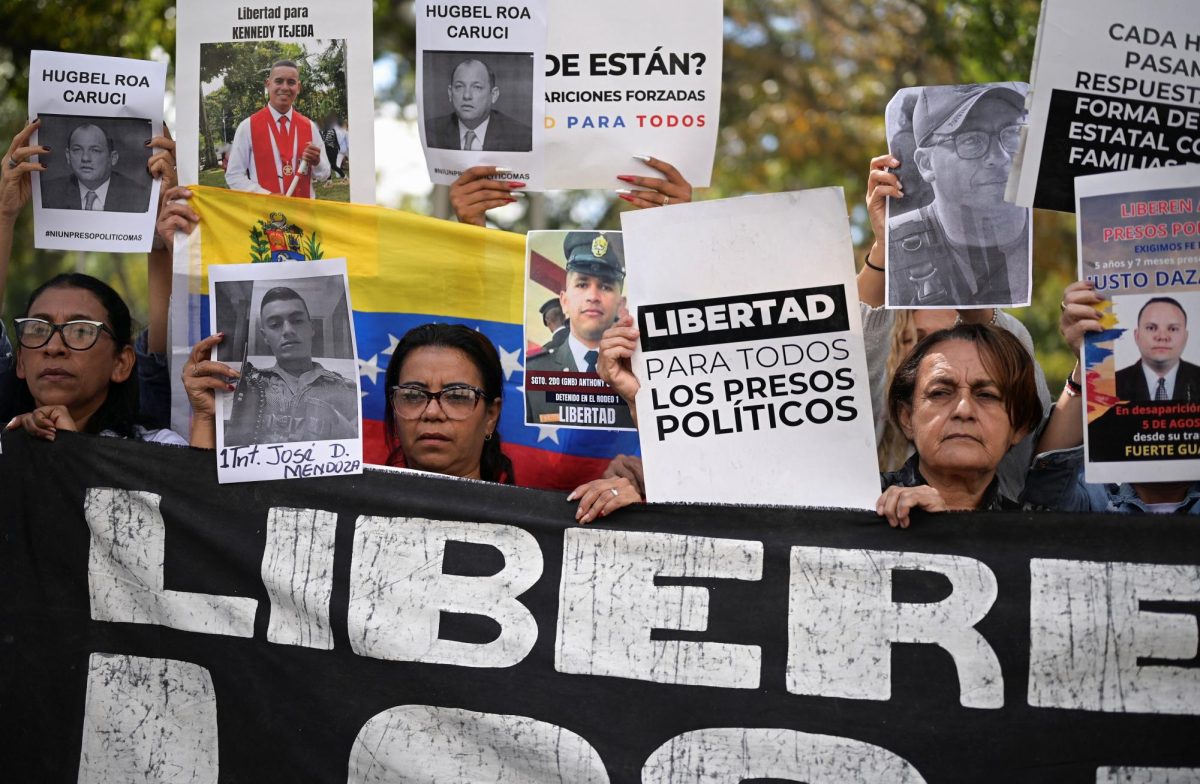
At the moment there is no statement or intention of a formal plan to hold free elections in Venezuela or respect the results of the 2024 elections, where the opposition managed to gather enough voting records to demonstrate the real result of the elections. There is only a fragile relationship between two authoritarian leaders, one of whom can be killed and replaced at any time.
Rodriguez has not only dealt with the external pressures of the different criminal groups in the country, who have lost their main collaborator, but has had to deal with the internal factions in the army, especially the paramilitary faction led by Diosdado Cabello – the most radical and the most reluctant to collaborate with the Trump administration.
At any moment there could be a new change in power, since Delcy could be killed or arrested, in addition to the fact that she is currently the most suspected of being the internal agent that the U.S. needed to capture Maduro.
On the other hand, the situation in Venezuela is far from changing. The power vacuum could encourage different groups as mentioned above to take power in general, or in targeted sectors, leading to a nationwide gang war.
At the moment there is no news about the Iranians, Russians and other foreign groups on Venezuelan territory, beyond some statements of the ELN and the FARC dissidences.
It seems that this success in Trump’s presidency is not a success at all, but only a half measure; a mediocre work that leaves an entire country exposed to descend into even more chaos without real solutions.
The intervention had to be carried out, but in a way that guaranteed from the first moment the freedom and independence of all Venezuelans, not only to pass the regime into other hands.