

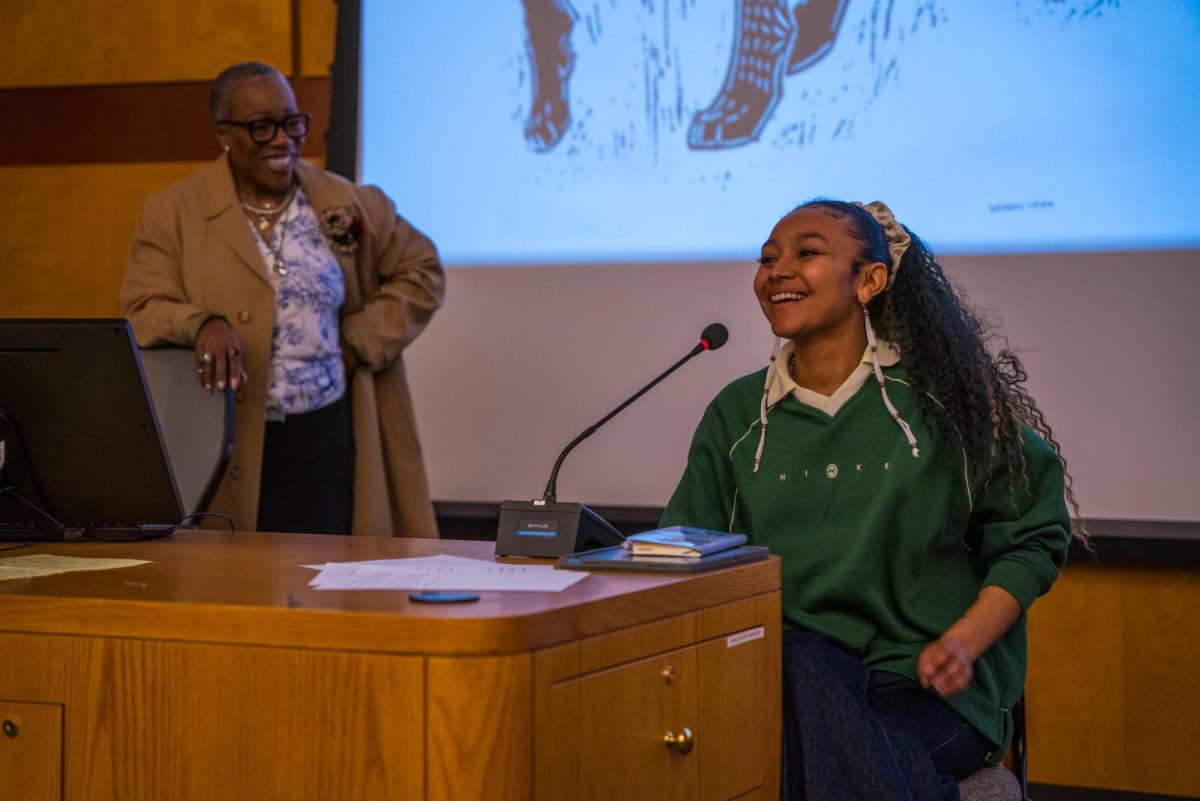
DeKALB — Indigenous artist Camille “Katahtu’ntha” Billie answered questions about her journey with art and advocacy in an open floor discussion on Wednesday in Cole Hall in Part 1 of her two-day event.
NIU’s Division of Academic Diversity, Equity and Inclusion hosted Billie, a Oneida and Diné printmaker, for a Q&A session, followed by a reception in the Pick Museum of Anthropology, which had five prints of Billie’s on display.
The first three prints on display depict a series of black dogs referred to as the “Rez Dogs.” These prints represent Billie’s experiences as a Native person balancing culture while living in a Western society.
In 2018, Billie moved from Oneida, Wisconsin, to Chicago, where she attended the School of the Art Institute of Chicago. There, she received her bachelor’s degree in fine arts with an emphasis in designed objects.
Amber Griffin, assistant director for Inclusion and Equity Education and moderator of the event, asked Billie about her experience as an Indigenous art student.
“I definitely spent a lot of time educating educators and helping create a foundation for more safe spaces for future Native kids coming into the Art Institute, which was really draining and led to a lot of burnout,” Billie said. “I’m looking out for the next generation, even if it’s at my own expense.”
The next two prints displayed at the museum depict a snake and a rabbit. The print of the snake represents the idea of being insatiable in a way that can be damaging to the environment.
“I do my best to remain mindful of my exchanges with hope to not feed a snake that will consume myself, the environment or my neighbors,” Billie said.
The second print depicts a rabbit and is described as a self-portrait of Billie during a time of great change in her life.
“May marks her acceptance of the unpredictability for the future and the readiness to adapt,” Billie said.
Vice President of Diversity, Equity and Inclusion Carol Sumner asked Billie if she had found a vacancy in the printmaking industry that she felt she had the capacity to contribute to post-graduation.
“Printmaking really resonated with me because it is high contrast,” Billie said. “It can be as tedious and not tedious as you want it to be. You’re setting the perimeters for yourself.”
Georgia Much, a first-year environmental studies major, asked if Billie found her “passion for the environment and environmental issues” while she was in art school or if she had always been interested in environmental activism.
In response, Billie discussed how her indigenous heritage and clan have influenced her environmental activism.
“Me being in the Turtle Clan means I am a keeper of the earth, “ Billie said. “People find different ways to uphold that responsibility, but this is how I have found my way.”
On March 19, the second part of the two-day event featuring Billie will take place at 2 p.m. in Jack Arends Hall, Room 408. It will be a printmaking workshop, open to all students and faculty.
