

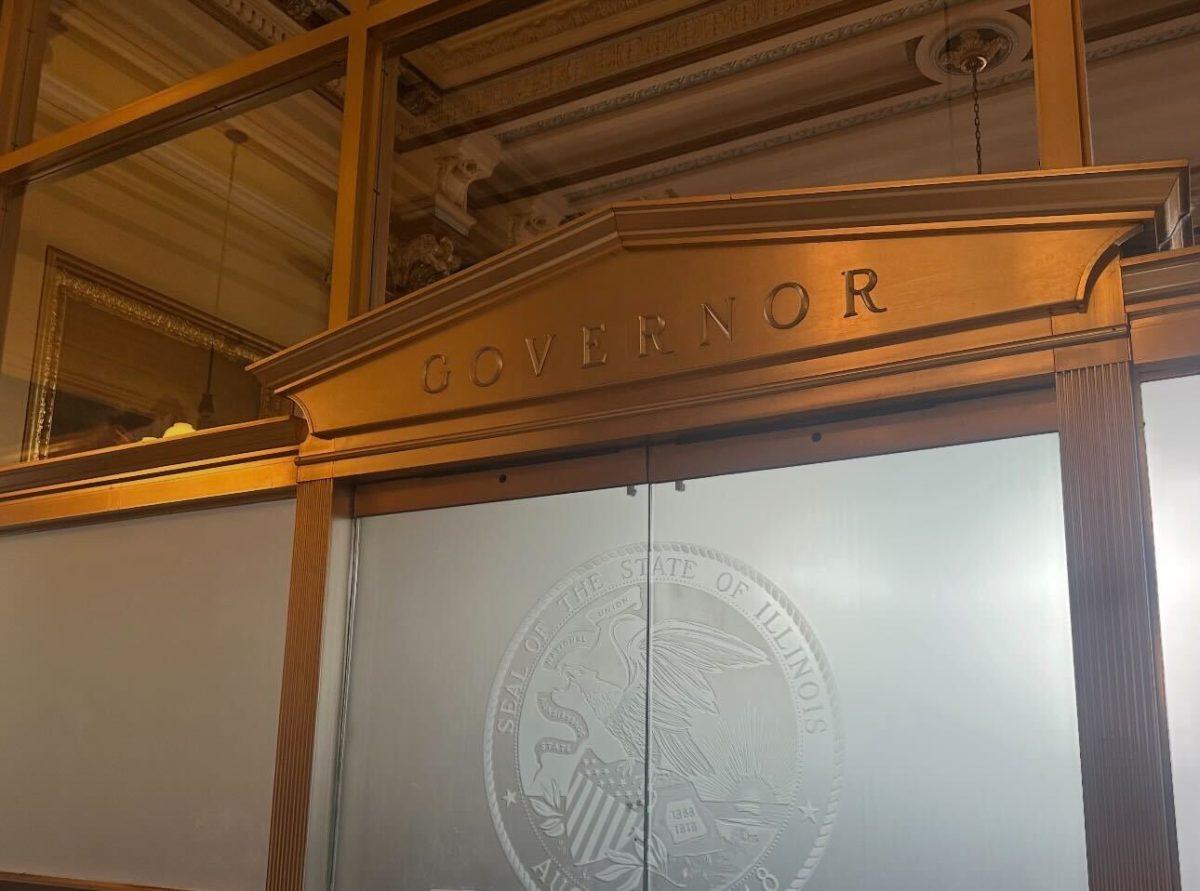
DeKALB – In February, Governor J.B. Pritzker proposed a $104 million budget for NIU. This proposal was $26 million short of the university’s requested budget, but other Illinois universities, such as UIUC, received a proposed budget of $746 million.
Public universities in Illinois have faced unstable and insufficient funding for decades, while also dealing with higher tuition and fees, which was around $5,000 higher than the national average in 2025.
In June 2021, the Illinois General Assembly passed Senate Bill 815, which created the Illinois Commission on Equitable Public University Funding. This bill established a statewide recognition that Illinois’ public university funding system needs improvement.
After three years of initial findings and recommendations, proposed legislation was introduced to install a new equitable funding formula in October 2024.
This funding formula calculates an “adequacy target” for public universities in Illinois, assessing the gap between the institution’s current resources and what is necessary to support its students.
This is based on the type of students it serves, such as low-income or first generation students. As well as the price of its tuition, some programs like engineering and medicine research could more expensive than other programs. Other avenues such as fees and current state funding are also taken into consideration.
The bill calculates an institution’s funding gap by subtracting its current resources from its adequacy target. If that institution is far below its target it would be considered underfunded.
Through the bill, the creation of an Accountability and Transparency Committee would advise the IBHE and keep track of the allocation of funding for all public universities.
According to the IBHE, more than 70% of people in Illinois are in support of increasing equity in funding public universities.
On April 8, a rally calling for this legislative action took place at the MLK Commons calling for this funding bill to be passed. This rally was held by the NIU professorial union.
Mark Van Wienen, an English professor and president of the NIU professorial union, explained that NIU has not been meeting its adequacy target.
“NIU is far off of the adequacy targets that they have established,” Van Wienen said. “If this bill were to be passed, it would bring a lot more money to NIU and would prioritize those institutions that are the furthest away from the adequacy targets in order to raise them up and move them to the position where they should be according to the state commission terms of funding our students.”
On March 27, a coalition of Illinois public universities released a joint statement calling for the passing of the Adequate and Equitable Funding Formula. NIU President Lisa Freeman took part in the statement.
“Illinois public universities are the foundation of our state and regional economies, preparing the skilled workforce employers depend on, driving research and innovation, and fueling development throughout our communities,” the statement reads. “The future of our state depends on the strength of public universities and their ability to advance student and community achievement. For these reasons, we stand united in support of the equitable funding formula, which will provide stable, predictable funding for every public university. That stability will help ease pressure on tuition, strengthen recruitment and enrollment, improve student outcomes, increase graduation rates, and grow economic investment – all of which will lead to a stronger, more successful Illinois.”
As of publication, HB1581 was successfully passed out of the House Higher Education Appropriations on March 26 in a 12-4 vote. SB13 is still being considered by the Illinois Senate Executive Committee. The deadline for the bill to be passed is May 31.
