

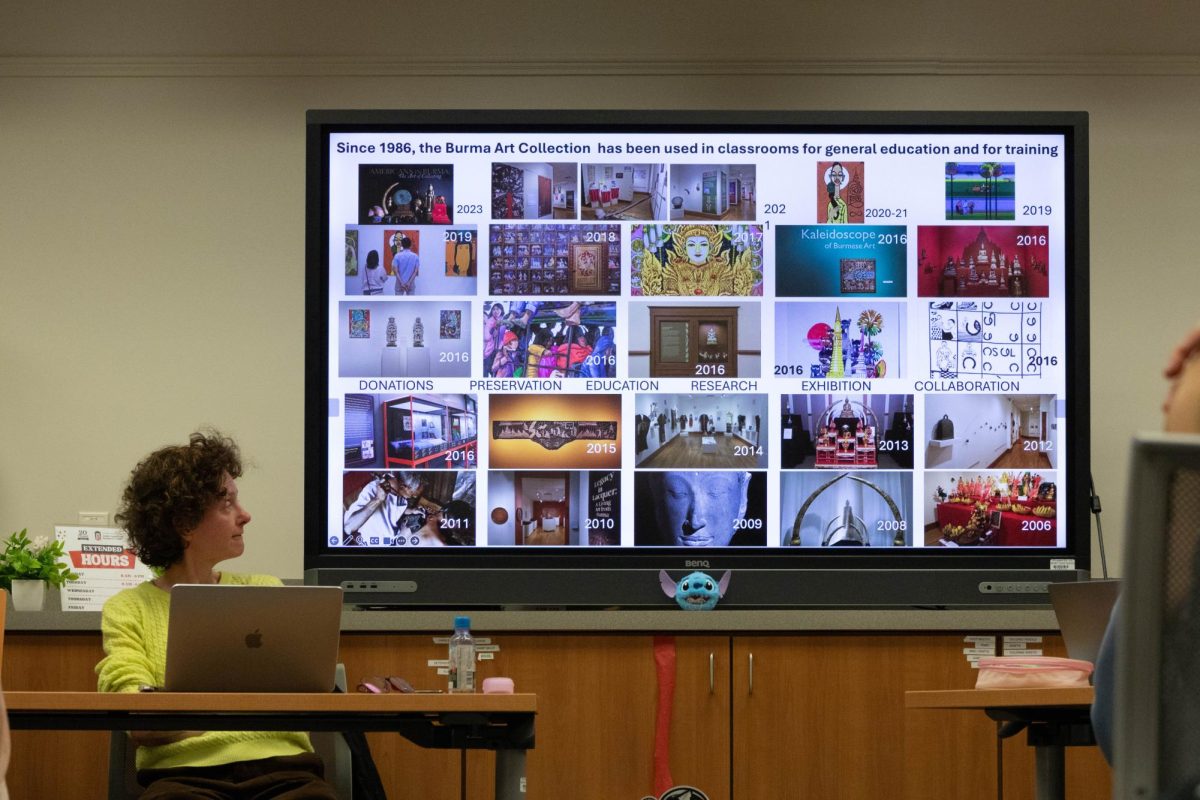
DeKALB – NIU’s Asian American Certificate Program hosted their last AACP lecture of the semester. The discussion covered Burmese culture and NIU’s Burman Art Collection from 5 p.m. to 6 p.m. Tuesday at the Asian American Resource Center.
The roundtable discussion was led by the Director of NIU’s Center for Burma Studies and associate history professor Aurore Candier. The panelists included both scholars and NIU students.
Candier began the discussion by highlighting the Burma Art Collection (BAC), which currently has items on display at the NIU art museum.
“Our main mission is to preserve and promote the Burma Art Collection,” Candier said. “That’s the reason the center was founded in 1986, because of this art collection.”
In addition to maintaining and promoting the BAC, the Center for Burma Studies shares Burmese culture in other ways as well. The center publishes the Journal of Burma Studies, a peer-reviewed academic journal that focuses solely on Burma, where one can learn about Burma and Myanmar’s ethnic nationality and diasporic cultures, through a variety of disciplines like economics and religious studies.
They also host the International Burma Studies Conference every two years. This conference lasts three days and consists of Burmese art exhibits, panels and music. The last conference was hosted at NIU in 2025.
Panelist Catherine Raymond, professor emerita of NIU and former director of the Center for Burma Studies, proposed a question: Is repatriation part of decolonizing museum practices?
Raymond said that it is. She referenced a 1,000-year-old Buddha statue that NIU rescued and returned to Myanmar after research proved the statue’s origin.
“Yes, of course it is,” Raymond said. “It’s part of history when you have a scholar doing all this research and showing that this Buddha was one of the rare 11 Buddha images existing in the 11th century in the first royal capital.”
Aye Myat Mon, PhD student panelist and president of the Burma Interest Association at NIU, discussed how culture is often overlooked when conflict is present.
“When we think about Barma, everybody thinks about conflicts and all the tragic moments in our country,” Mon said. “But what we did not see is our culture.”
Students interested in the Burma Interest Association can visit their page on Huskie Hub.
The NIU Art Museum, located on the first floor in Altgeld Hall, is currently hosting the art exhibition, “Legacies on Display: The Forbidden and Venerated Arts of Burma.” The exhibition will feature 19th and 20th century Burmese art and artifacts through May 9.